The barbed thread lift has become one of the most requested treatments for jawline definition among patients who want a visible lift without surgery. Unlike smooth threads, which rely mainly on stimulating collagen over time, barbed threads have tiny cogs or barbs along their length that physically grip surrounding tissue — giving an immediate mechanical lift alongside the longer-term regenerative benefit.
How Barbed Threads Actually Work
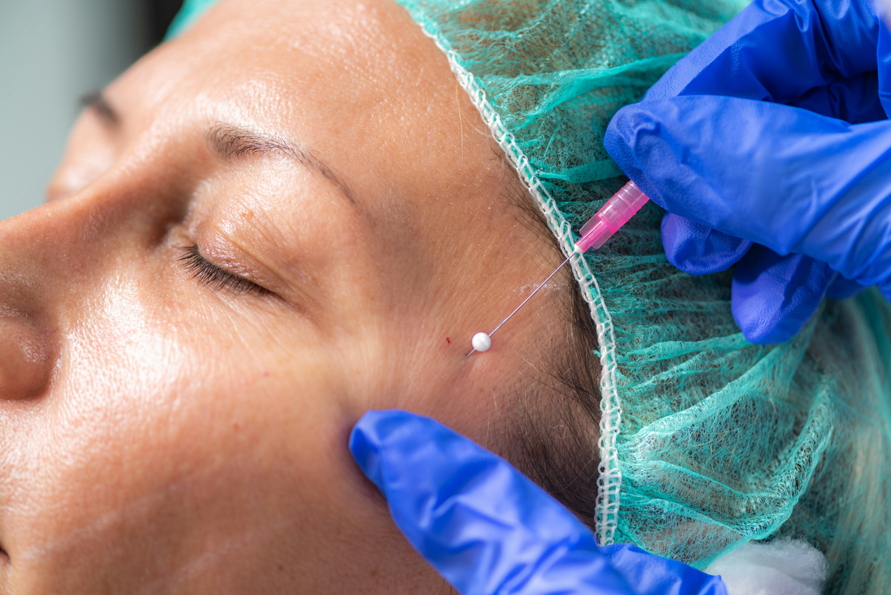
A Thread Lift using barbed threads involves inserting fine, dissolvable threads beneath the skin using a needle or cannula, positioned along a carefully mapped vector matched to the direction of natural facial support structures. Once in place, the barbs anchor into the tissue and, when gently tensioned, lift and reposition sagging skin immediately — a mechanical effect distinct from filler, which adds volume rather than repositioning existing tissue. Over the following months, the thread material also stimulates a genuine collagen response as the body reacts to its presence, meaning the treatment offers both an immediate cosmetic lift and a slower-building regenerative benefit.
Why the Jawline Specifically
The jawline has become the barbed thread lift’s signature use case because it’s an area where a mechanical lift genuinely matters — sagging along the jaw and jowls is largely a positional problem, tissue that has descended rather than simply lost volume, which barbed threads are specifically designed to correct by repositioning rather than filling. This distinguishes the approach from Jaw Filler / Enhancement, which adds structure and definition through volume, addressing a different underlying cause of jawline concerns. Many practitioners now assess whether a patient’s jawline concern is primarily volume loss or primarily descent before recommending filler, threads, or a combination of both.
What the Treatment Feels Like and What to Expect
Local anaesthetic is typically used at insertion points, and most patients describe pressure and pulling sensations during placement rather than significant pain. Some bruising, swelling, and a sensation of tightness are expected for the first week or two, and visible dimpling at entry points usually settles within days as swelling resolves. The lifting effect is often visible immediately, though final results, including the added collagen-stimulation benefit, continue to develop over the following two to three months.
How Long Results Actually Last
Barbed thread lift results typically last twelve to eighteen months, though this varies based on thread type, the number of threads used, and individual factors like skin quality and rate of tissue ageing. This is shorter than a comparable surgical facelift but considerably longer than most injectable treatments, positioning barbed threads as a genuine middle ground between filler-based approaches and surgery in terms of both cost and longevity.
Who It Suits, and Who It Doesn’t
Barbed threads work best for mild to moderate sagging — patients with more significant jowling or excess skin often see more modest results than the marketing sometimes implies, and a proper consultation should be honest about where the technique’s limits actually are. It’s frequently combined with complementary treatments such as Non-Surgical Facelift approaches using Hyaluronic Fillers, or Wrinkle Reduction work elsewhere on the face, rather than being used as a single standalone solution for comprehensive facial ageing.
The Takeaway
Barbed thread lifts offer something genuinely distinct in the non-surgical space: an immediate mechanical repositioning effect combined with a slower collagen-stimulating benefit, specifically well suited to jawline sagging that filler alone can’t correct. It isn’t a replacement for surgery in more advanced cases, but for the right patient and the right degree of sagging, it’s redefined what’s achievable without going under a scalpel.