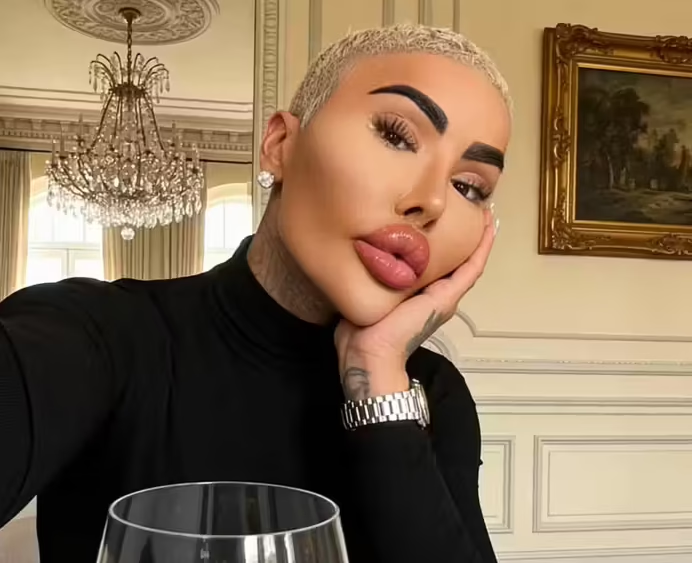
We lost a notable figure in the world of extreme aesthetics recently. Jordan Parke, widely known in the media as the “Lip King,” passed away at just 33 years old. If you aren’t familiar with him, he was one of those larger-than-life personalities who became famous for spending a fortune—reportedly over £185,000—on cosmetic procedures to look like his idol, Kim Kardashian.
When news like this breaks, the internet usually reacts in two ways. There’s the immediate shock and sadness for a young life gone too soon. But then, almost instantly, there’s the judgment. People flood comment sections with cruel remarks about his appearance, his choices, and his lifestyle. It’s easy to look at someone with extreme modifications and label them as “vain” or “delusional,” but that misses the point entirely.
The tragedy of the “Lip King” isn’t just about one man’s choices; it’s a mirror held up to a society that is relentlessly obsessed with optimisation.
The Pursuit of the “Insta-Face”
Jordan didn’t wake up one day and decide to undergo dozens of surgeries in a vacuum. He existed in the same world we do—a world where our phones constantly feed us images of poreless skin, impossible waistlines, and perfectly plumped pouts.
We live in the era of the “Instagram Face.” It’s that ethnically ambiguous, cyborg-esque look characterised by high cheekbones, cat-like eyes, and, of course, full lips. Filters have normalised this aesthetic to the point where actual human faces look… wrong. We see a normal nose or thin lips and think they need fixing.
I remember chatting with a friend recently who was considering getting fillers. She’s gorgeous, with a unique, interesting face. But she showed me a filtered selfie and said, “I just want to look more like this in real life.” That’s the trap. We aren’t competing with other people anymore; we are competing with digital avatars of ourselves.
Extreme Makeovers vs. “Tweakments”
While Jordan’s transformation was extreme, the impulse behind it is incredibly common. We might not all be spending six figures to look like a celebrity, but how many of us have succumbed to “preventative Botox” in our twenties? Or teeth whitening? Or just sucking in our stomachs for a photo?
The line between a “tweakment” and an obsession is blurrier than we like to admit. Society applauds subtle work—”Oh, she looks so rested!”—but mocks the extreme results. We tell people, “Fix your flaws, but don’t let anyone know you fixed them.” It’s a paradoxical pressure cooker. You have to be beautiful, but effortlessly so. If you try too hard, you’re ridiculed. If you don’t try hard enough, you’re invisible.
Jordan took that pressure and ran with it to its logical, extreme conclusion. He didn’t hide the work; he celebrated it. In a way, his transparency was more honest than the celebrities who claim their changing faces are just the result of “puberty” or “good olive oil.”
Where Do We Draw the Line?
The loss of the Lip King is a sad moment. Underneath the fillers and the ink, there are real people looking for acceptance, confidence, or just a way to feel comfortable in their own skin.
Maybe it’s time we stop pointing fingers at the individuals who go “too far” and start questioning the culture that sets the destination. Why are we so terrified of aging? Why is “natural” synonymous with “flawed”? Why do we value a curated aesthetic over authentic character?
At the end of the day, we’re all just trying to navigate this weird, filtered world the best way we know how.